
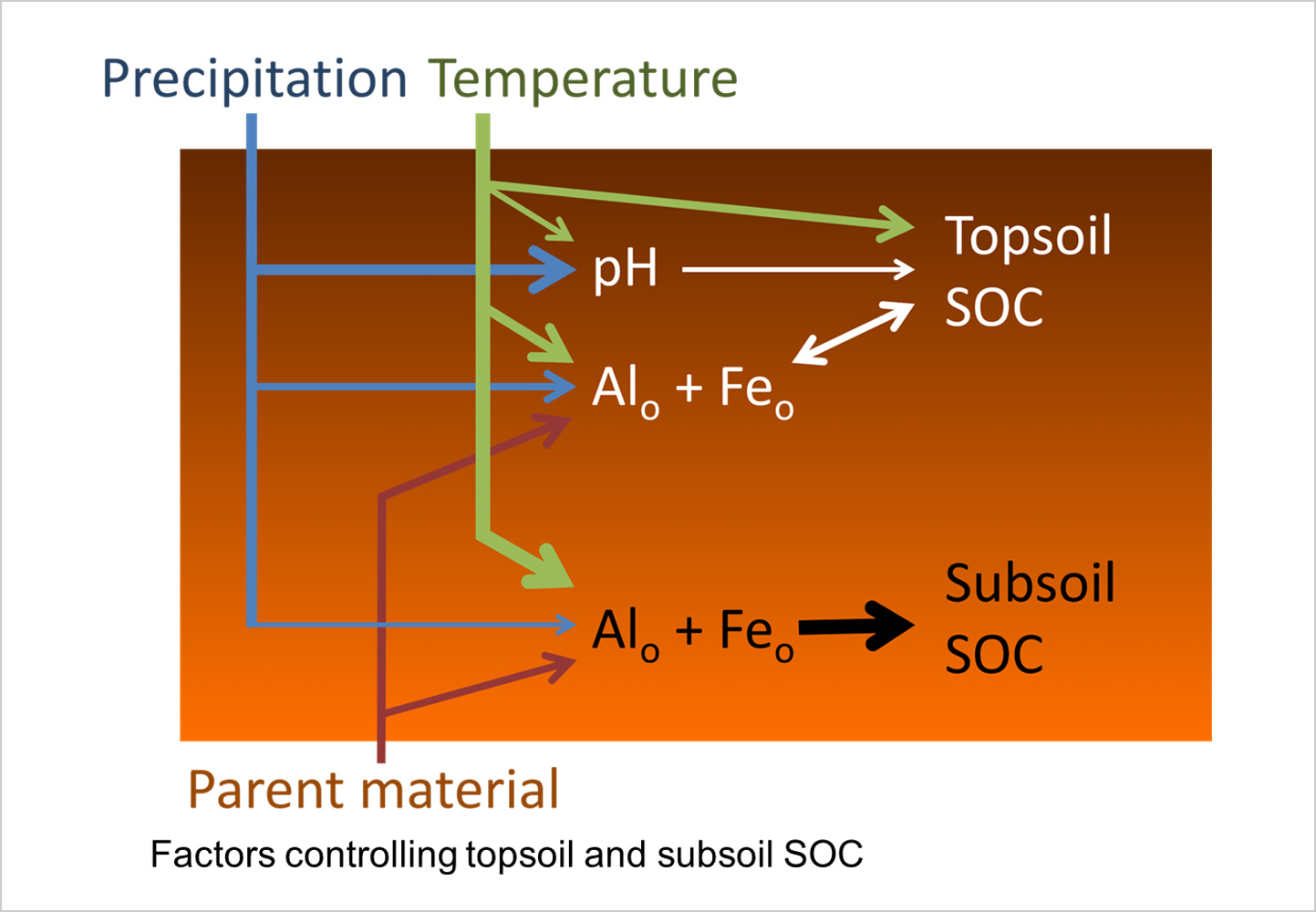
This study elucidates the mechanisms of soil organic carbon (SOC), the core for climate regulation and healthy terrestrial ecosystems, accumulation in tropical and temperate non-volcanic regions, identifying active aluminum and iron (Al/Fe) as the primary factors across different soil depths. Analysis using Random Forest Regression and Structural Equation Modeling revealed that while topsoil SOC is regulated by a bidirectional interaction between active Al/Fe, temperature, and pH, subsoil SOC is predominantly controlled by a powerful, unidirectional influence from active Al/Fe. Notably, the study identified that climate (excess precipitation) and parent material chemical composition do not always affect SOC directly; instead, they indirectly dictate SOC distribution by regulating the formation and content of active Al/Fe.
These findings demonstrate that mineralogical stabilization via active Al/Fe is the fundament to carbon sequestration even in non-volcanic soils, providing a critical framework for refining high-precision SOC dynamic models and accurately evaluating carbon sequestration potential in response to climate change.
Lyu, H., et al., Geoderma 458: 117335, 2025. DOI: https://doi.org/10.1016/j.geoderma.2025.117335
