
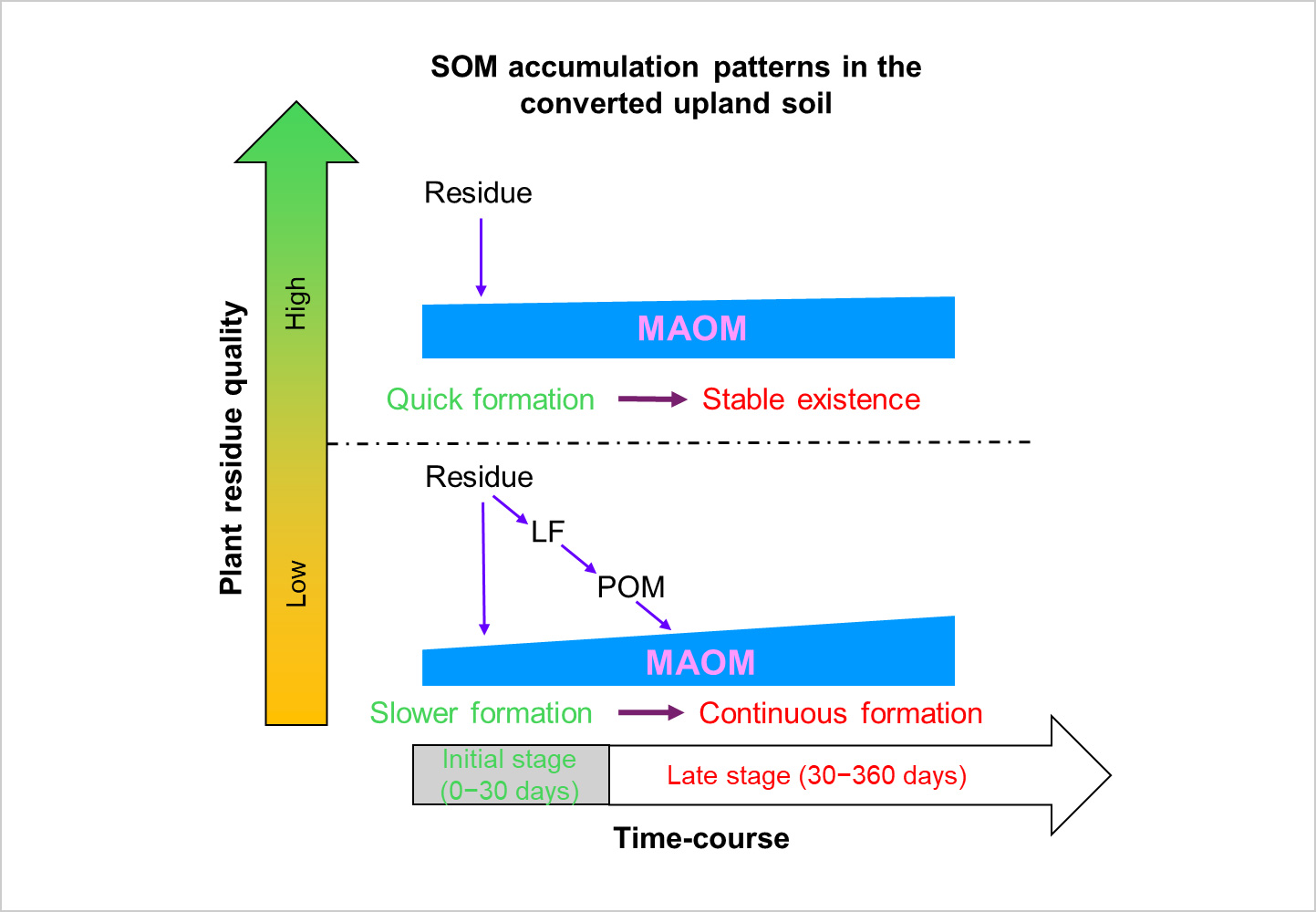
The conversion of lowland paddy fields to upland drastically changes the soil environment and quality of supplied plant residues (roots, stems, leaves), impacting soil organic matter dynamics. In this study, we used 13C/15N-labeled soybean and maize residues of varying parts to elucidate how residue quality (i.e., C:N ratio and lignin content) affects the formation process of Mineral-Associated Organic Matter (MAOM)—the most stable pool of soil organic carbon—through a one-year in-situ incubation experiment. Our analysis revealed that residue quality is the primary factor determining both the rate and pathway of MAOM formation. High-quality residues, such as soybean leaves, were rapidly transformed by microbes into MAOM during the initial stage (within 30 days). In contrast, low-quality followed a pathway of long-term, continuous transformation from particulate organic matter (POM) into MAOM. Ultimately, soybean roots exhibited the highest MAOM accumulation (28.3%) due to an optimal balance between rapid initial decomposition and sustained long-term transformation. These findings suggest that management strategies based on the quality of supplied residues are crucial for enhancing the carbon sequestration of converted upland soils.
Dang, L.V., et al., Environmental Research 283: 122158, 2025. https://doi.org/10.1016/j.envres.2025.122158
