
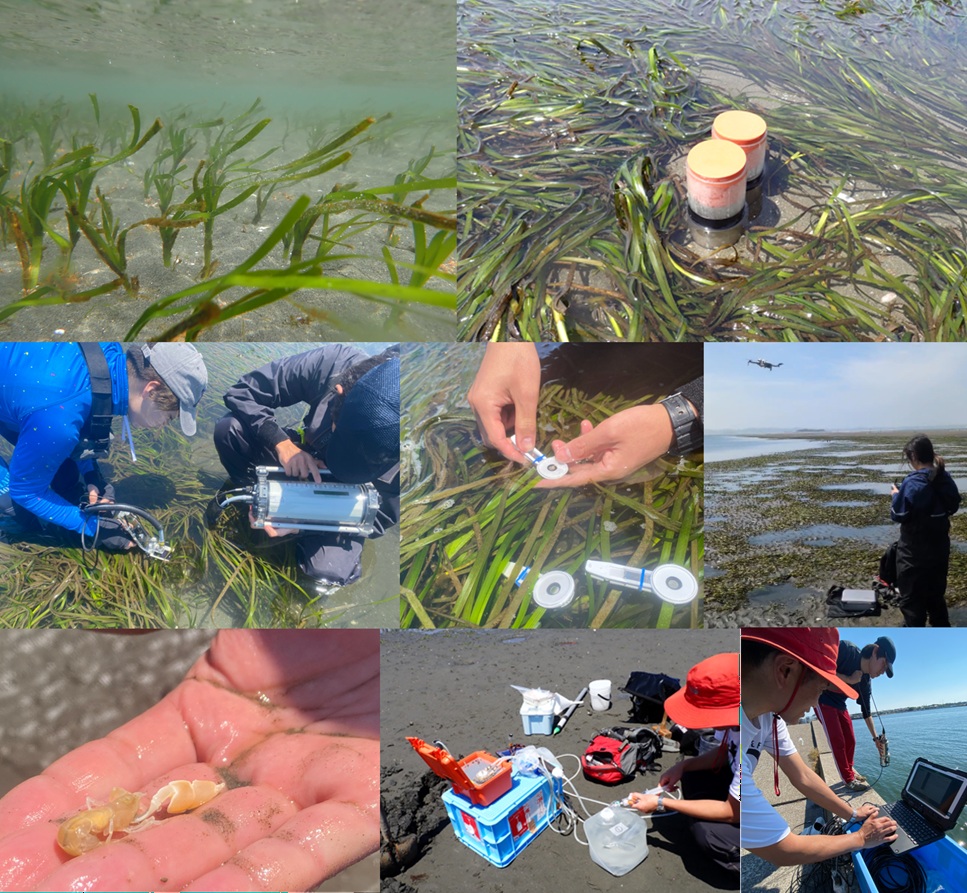
In temperate regions, eelgrass (Zostera marina) is the primary species of seagrass that plays an essential role as one of the “blue carbon species”, and it performs a variety of ecosystem functions. However, seagrass beds are deteriorating due to rising sea temperatures, eutrophication, and increasingly powerful typhoons, creating a need for the development of seagrass bed restoration technologies. This practical training aims to understand the functions of seagrass beds and acquire restoration techniques, covering topics such as “sediment sampling methods for interstitial water extraction and organic matter measurement”, “observation of flowering shoots of Z. marina”, “mapping of seagrass bed using drone” “measurement of photosynthetic parameters using PAM”, “water quality measurement using a multi-parameter water quality meter”, “seawater sampling for analysis of radioactive isotopes (Rn and Ra nuclides) as indicators of groundwater discharge”, and “observation of benthic organisms in tidal flats”. Participants will analyze the samples in the laboratory and discuss the results.
